

Sangeet is the one night of your wedding where you get to be a little less bride and groom, and a little more you. The lights are low, the music is loud, and every phone in the room is pointed at the two of you — which is exactly why the colour you pick matters more than the embroidery on it.
This guide gives you 12 couple colour combinations that photograph well under warm venue lighting, hold up on a dance floor, and look expensive without looking like everyone else's Pinterest board. Each one comes with a premium designer direction for her and for him, so you know where to actually start shopping.
Short on time? The safest sangeet couple colours are ivory and antique gold, emerald and blush pink, and midnight blue and rose gold — all three read beautifully under warm lighting. The most current for 2026 are jet black with molten silver, butter yellow with ivory, and burnt orange with teal. Do not match exactly; pick one shared colour and let each outfit interpret it differently.
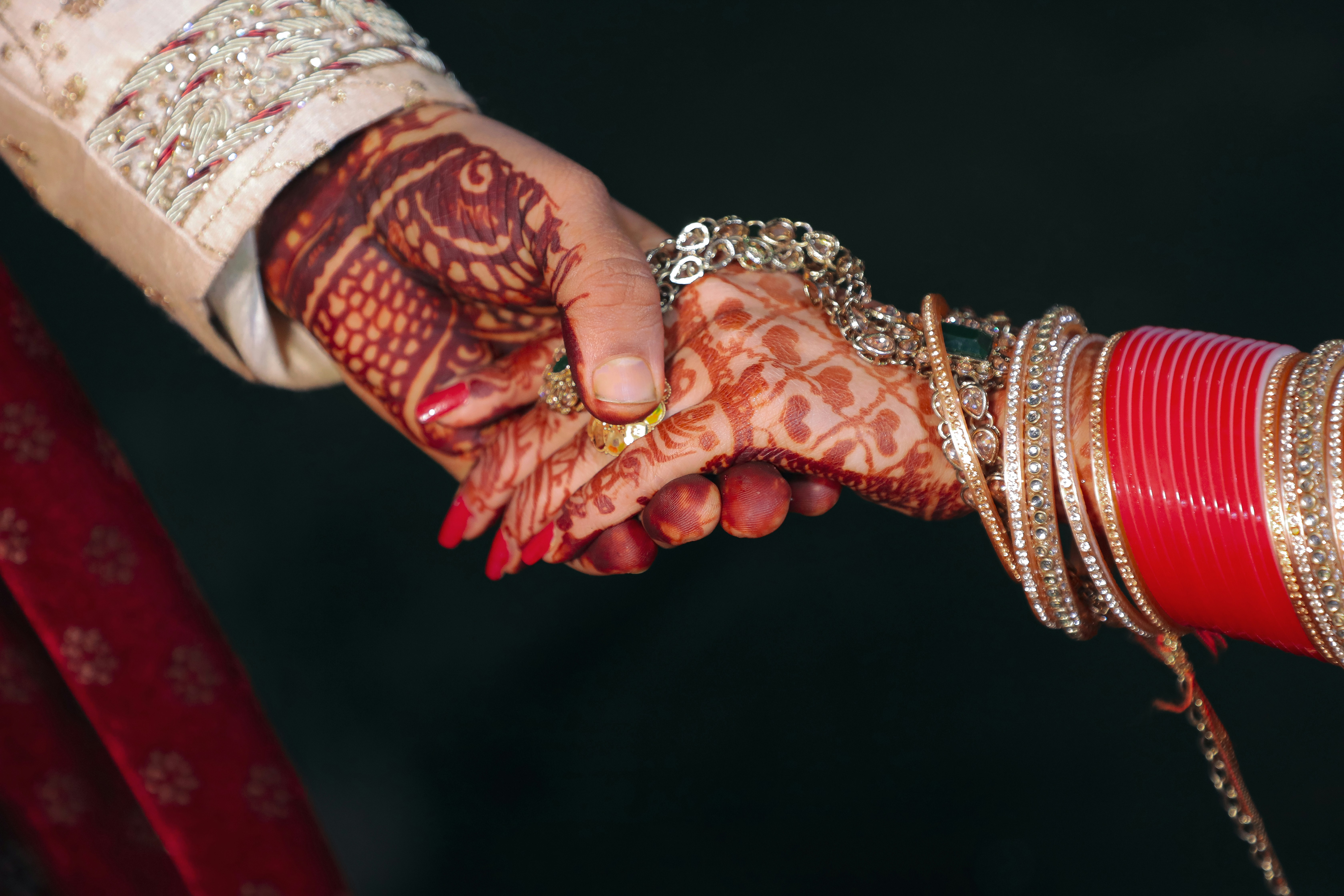
Coordinate, don't match — one shared colour, worn as the hero in one outfit and an accent in the other.
The one rule that makes couple colours work
Matching is out. Coordinating is in.
When a couple wears the exact same shade head to toe, the eye stops seeing two people and starts seeing one block of colour. In photographs, you merge. What works instead is a shared anchor with different weights: one colour appears in both outfits, but as the hero in one and as a detail in the other.
So if she wears an emerald lehenga with blush pink work, he wears a blush pink kurta with emerald buttons or an emerald pocket square. Same story, two chapters. This is the approach most stylists use for celebrity sangeets, and it is the reason those photos read as intentional rather than costume-y.
Try this: pick your two colours. Give her 70% of colour A and 30% of colour B. Give him 70% of colour B and 30% of colour A. That single flip is what separates "coordinated" from "matching".
Why sangeet lighting changes everything
Sangeet is almost always an evening or night function, lit with warm amber uplights, fairy lights and a lot of gold. Warm light does three things to fabric:
It flattens pastels. Baby pink, mint and powder blue can go grey or muddy after dark. They are gorgeous for mehendi and haldi in daylight, riskier for sangeet.
It supercharges jewel tones. Emerald, sapphire, ruby and amethyst were made for candlelight. They deepen instead of dulling.
It turns silver slightly warm and gold slightly molten. Metallics are your friend here — they catch every light source in the room.
If your sangeet is a daytime or poolside event, or you are having a destination sangeet with an outdoor sunset slot, flip the logic: pastels and earthy tones win, and heavy jewel tones can feel too much.
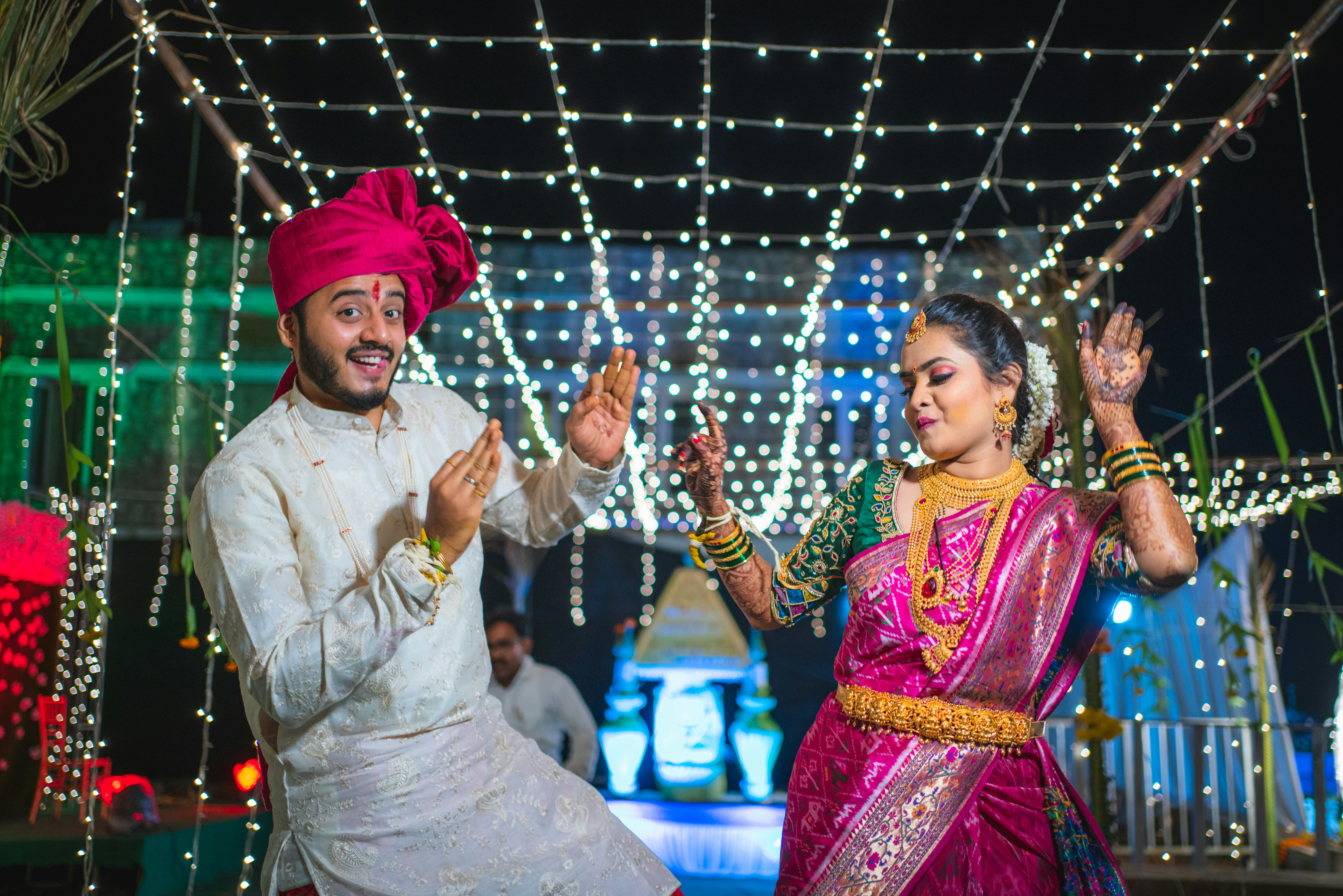
Warm venue lighting deepens jewel tones and softens pastels — plan your colour around the light, not just the outfit.
The 12 couple outfit colour combinations for sangeet
1. Ivory & antique gold — the one that never dates
If you want photographs you will still like in twenty years, start here. Ivory with old-gold zardozi is quiet, expensive and completely unbothered by trends. It also has a practical advantage: it reflects warm light instead of absorbing it, so both of you stay bright in every frame even in a dim banquet hall.
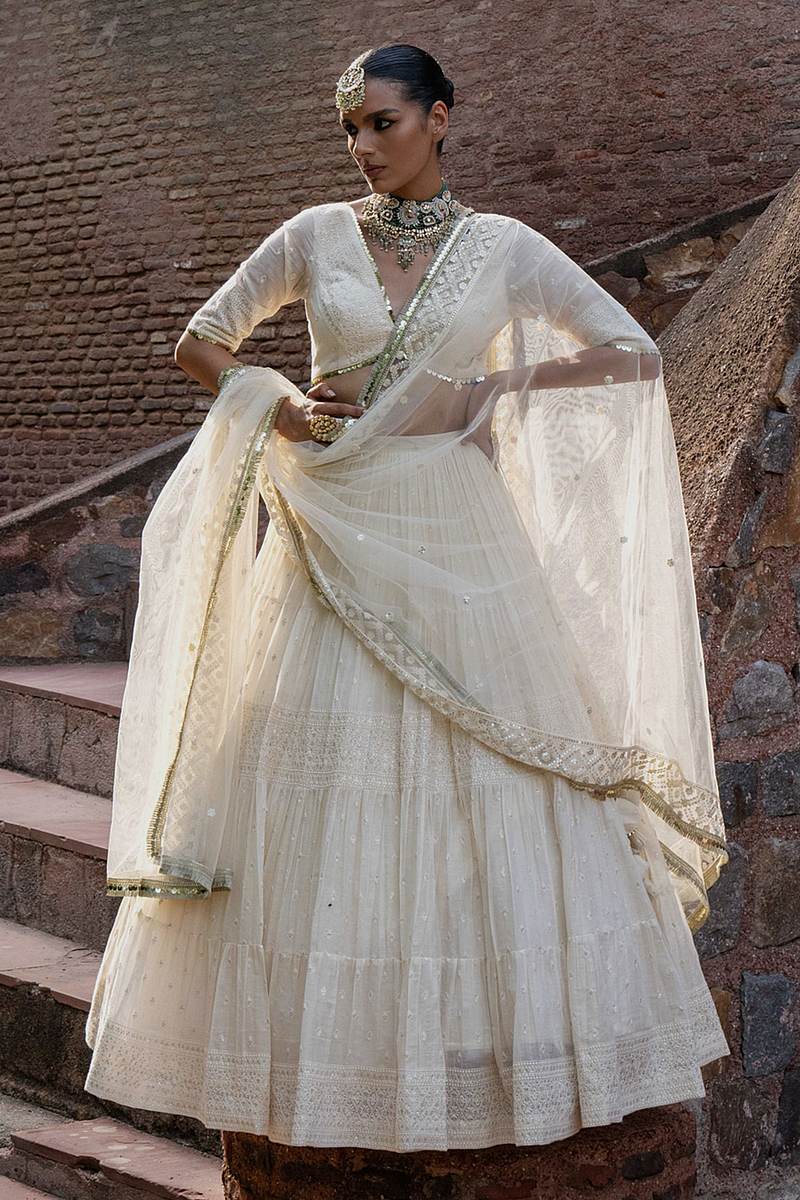
Pictured: ivory-and-gold bordered lehenga, Preevin at Aza. azafashions.com
For her: An ivory lehenga with antique gold zardozi or tilla work. Sabyasachi and Abu Jani Sandeep Khosla are the reference points for this kind of heirloom-weight embroidery; Rimple & Harpreet Narula if you want a more Mughal, historically-rooted version.
For him: An ivory or oyster sherwani with gold hand embroidery. The House of Rohit Bal ivory-and-gold sherwani is the archetype. For something leaner, a Raghavendra Rathore ivory bandhgala with gold buttons.
Best for: Palace and haveli venues, black-tie-leaning sangeets, couples who want understated.
2. Jet black & molten silver — the 2026 statement
Black had a genuine moment at India Couture Week 2026 — the House of Rohit Bal built its jet-black Dastkar collection around it, and Falguni Shane Peacock used it for its commanding, polished quality. Pair it with liquid silver rather than gold and you get something closer to fashion than to wedding wear.
The trick with black at a sangeet is texture. Flat black disappears in low light. You want sequins, mirror work, metallic thread or a high-sheen fabric so the outfit catches every beam on the dance floor.
For her: A black lehenga or draped gown with dense silver sequin or crystal work — Falguni Shane Peacock for full drama, Gaurav Gupta for a sculptural drape, or Rimzim Dadu for her signature molten metallic surfaces.
For him: A black bandhgala or textured sherwani with silver-grey detailing. Shantnu & Nikhil for a structured, military-inspired cut; Kunal Rawal for a modern, layered take.
Best for: Urban hotel sangeets, late-night cocktail-sangeet combos, couples who want to look modern rather than traditional.
3. Emerald green & blush pink — regal meets soft
This is the most reliable jewel-tone pairing in Indian weddings, and it earns its popularity. Emerald carries the weight and the richness; blush pink stops it from feeling heavy or masculine. Under warm light, emerald goes deeper and blush picks up a candlelit glow. It is very hard to get wrong.
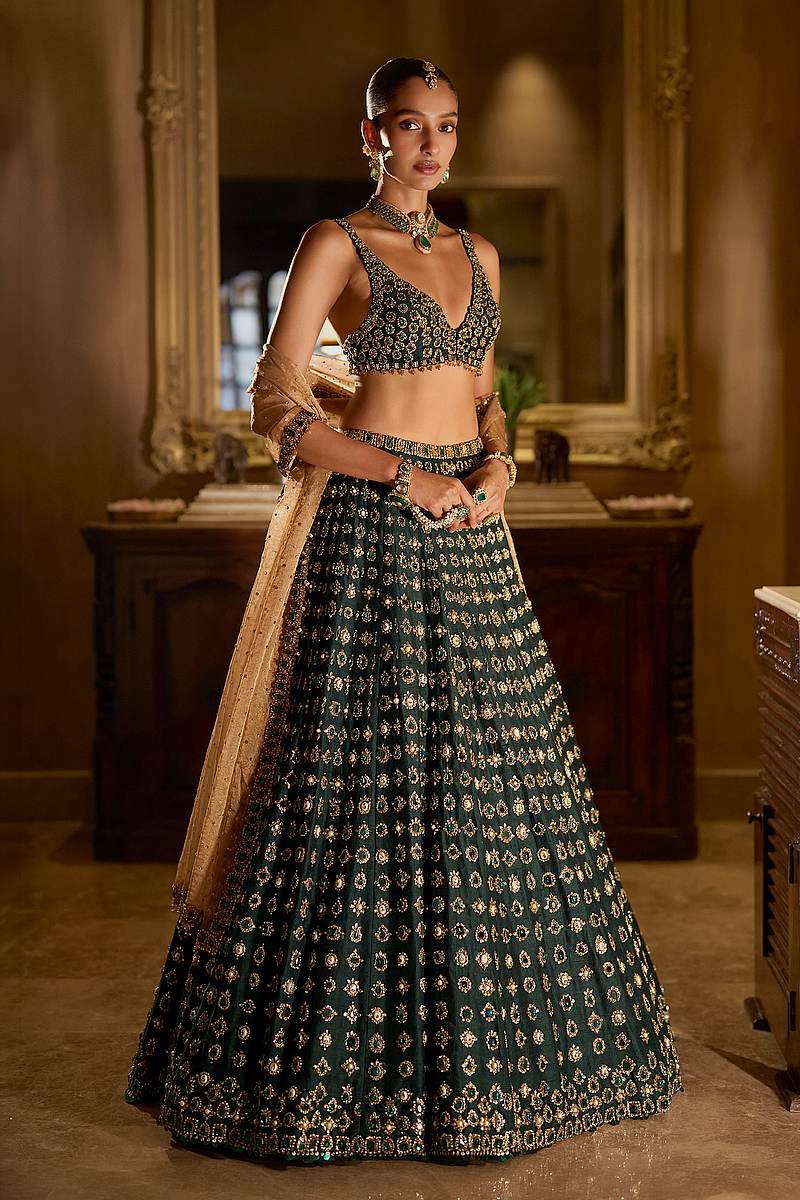
Pictured: emerald stone-and-zardozi lehenga, Seema Gujral at Aza. azafashions.com
For her: An emerald lehenga with blush pink dupatta or blush floral work. Sabyasachi is the obvious reference for deep emerald with heritage embroidery; Anita Dongre for a lighter, gota-patti-led version.
For him: A blush or dusty rose kurta set or sherwani with emerald buttons and an emerald stole. Manish Malhotra for polished glamour, Tarun Tahiliani for a draped, comfortable silhouette.
Best for: Almost any venue. This is the safe-but-beautiful choice.
4. Burnt orange & teal — the ICW 2026 pairing
Arpita Mehta sent burnt orange, teal and royal purple down the runway at India Couture Week 2026 across sculpted lehengas and fluid drapes, and the orange-teal combination in particular has moved fast into real weddings. It is a complementary pairing, which is a polite way of saying the two colours make each other look brighter.
This is a confident choice. It photographs loudly and it works especially well against neutral décor — beige marquees, sandstone courtyards, white florals.
For her: A burnt orange lehenga or a fluid teal drape with orange embroidery. Arpita Mehta for the exact reference, Anamika Khanna for a modern draped interpretation.
For him: A teal bandhgala or kurta with burnt orange accents, or the reverse. Jatin Malik and Shantnu & Nikhil both cut this kind of saturated menswear well.
Best for: Rajasthan and desert-palace venues, autumn and winter sangeets.
5. Butter yellow & ivory — the soft trend colour
Butter yellow has been the breakout soft shade across 2026 wedding wardrobes — warmer than lemon, richer than cream, and much kinder to Indian skin tones than a true pastel. Paired with ivory rather than white, it stays warm instead of going clinical.
One caveat: this is a daylight-leaning combination. If your sangeet starts at sunset or is held outdoors, it will look extraordinary. In a dark banquet hall after 9pm, it can lose energy — so ask for gold embroidery or metallic tissue to give it something to reflect with.
For her: A butter yellow organza or tissue lehenga with gold or ivory thread work. Anita Dongre and Abhinav Mishra both do this softness with lightweight, dance-friendly construction.
For him: An ivory kurta set with butter yellow detailing, or a butter-yellow Nehru jacket over ivory. Anita Dongre Men or Tarun Tahiliani.
Best for: Daytime, poolside and sunset sangeets; summer and spring weddings.
6. Pistachio green & off-white — 2026's quiet breakout
Softer than emerald, warmer than mint — pistachio has become the pastel that stylists actually recommend, largely because it flatters a far wider range of skin tones than baby pink or powder blue. Against gold embroidery it turns genuinely luxurious.
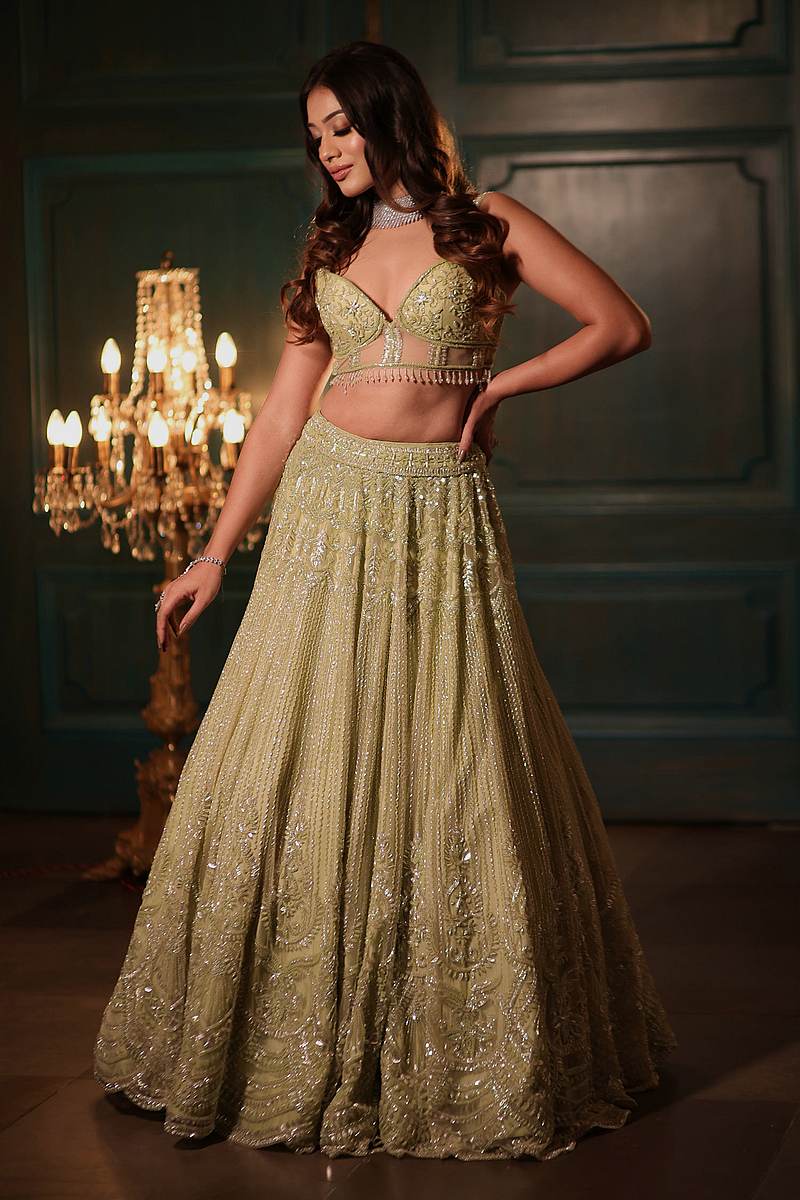
Pictured: pistachio embroidered lehenga, Isa by Dolly Wahal at Aza. azafashions.com
For her: A pistachio lehenga or sharara with gold zari. Anita Dongre for the eco-conscious, hand-crafted route; Vvani by Vani Vats for delicate, romantic embroidery; Seema Gujral for a more contemporary, structured silhouette.
For him: An off-white sherwani or bandhgala with pistachio thread work and a pistachio stole. Raghavendra Rathore for the tailored bandhgala, Kunal Rawal for a relaxed layered set.
Best for: Garden sangeets, spring weddings, couples who want fresh rather than heavy.
7. Midnight blue & rose gold — modern and universally flattering
The classic update on navy-and-gold. Rose gold is softer and warmer than yellow gold, which means it flatters more skin tones and reads more contemporary in photographs. Midnight blue behaves like black under low light but keeps a colour depth that black loses.
For her: A midnight blue lehenga with rose gold sequin or dabka work. Manish Malhotra is the reference for this exact register of shimmer; Falguni Shane Peacock for something more embellished.
For him: A midnight blue bandhgala with rose gold buttons, or a rose gold textured sherwani. Shantnu & Nikhil or Raghavendra Rathore.
Best for: Hotel ballrooms, winter sangeets, couples who want polish without drama.
8. Royal purple & champagne gold — underused and regal
Purple was one of the colours designers pushed hardest at ICW 2026 — Aisha Rao showed it across dramatic lehengas, and Arpita Mehta used royal purple alongside her orange and teal. It carries the same regality as maroon without being the shade every second bride is wearing.
Champagne gold is the right partner because full yellow gold competes with purple. Champagne recedes and lets the purple lead.
For her: A royal purple or amethyst lehenga with champagne embroidery. Aisha Rao for the embellished version, Tarun Tahiliani for a lighter draped one.
For him: A champagne or beige-gold sherwani with purple detailing and a purple safa. Manish Malhotra or Jatin Malik.
Best for: Grand venues, evening sangeets, couples who want jewel-toned but not predictable.
9. Wine & dusty rose — warm, adult, photographs beautifully
Wine is the grown-up version of maroon: less bridal-red, more velvet-and-candlelight. Dusty rose softens it without going sweet. This is one of the most forgiving pairings for mixed-age wedding parties, because it looks appropriate on parents and cousins in the group photos too.
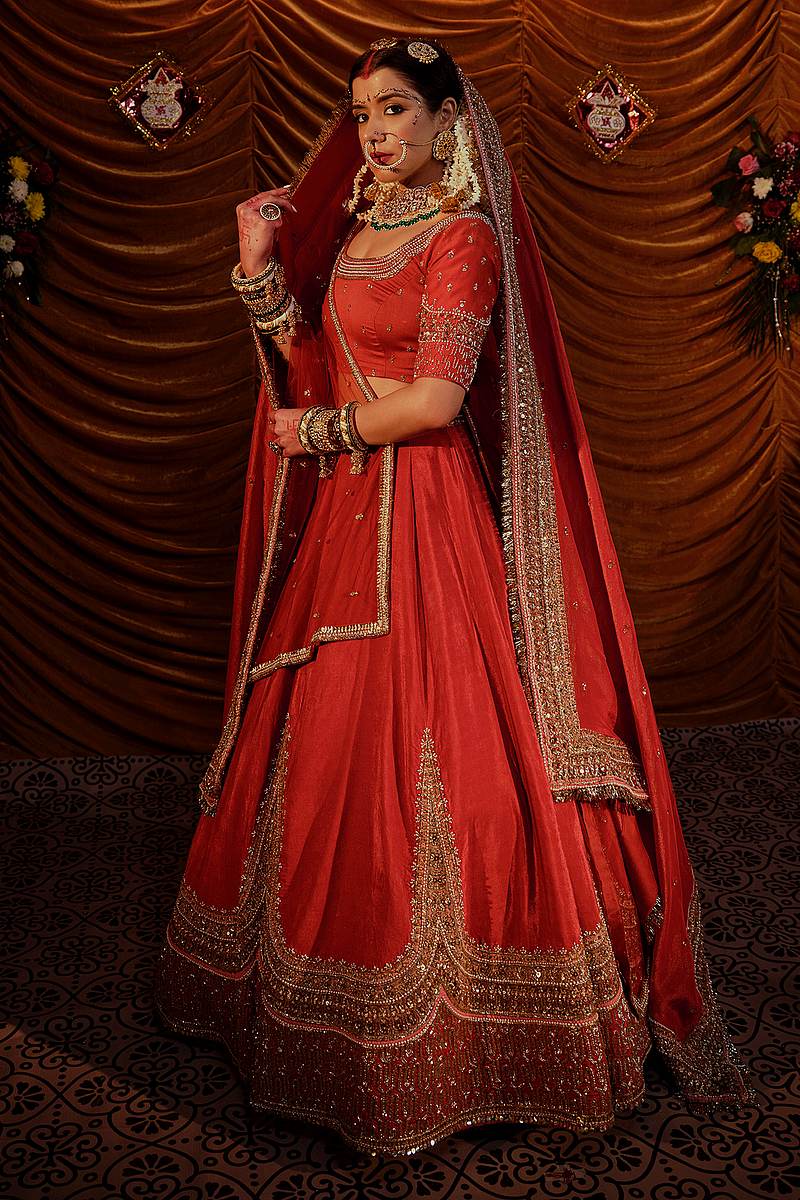
Pictured: wine velvet lehenga with gold beadwork, Payal & Zinal at Aza. azafashions.com
For her: A wine velvet or silk lehenga with dusty rose and gold work. Sabyasachi for velvet, Mrunalini Rao for a vintage-leaning romantic version.
For him: A dusty rose kurta or sherwani with a wine velvet Nehru jacket. House of Rohit Bal for velvet bandhgalas, Kunal Rawal for a softer modern silhouette.
Best for: Winter weddings, candlelit venues, intimate sangeets.
10. Fuchsia & papaya orange — bold colour-blocking
Colour-blocking two saturated brights is one of the defining moves of 2026 bridal wear, and fuchsia with papaya orange is its loudest, happiest expression. It is the most "sangeet" combination on this list — high energy, unmissable in video, and impossible to look sombre in.
Use gold embroidery as the bridge between the two shades. Without it, the pairing can feel like two outfits shouting; with it, it reads deliberate.
For her: A fuchsia lehenga with papaya orange dupatta, or a colour-blocked set. Masaba Gupta for bold and expressive, Arpita Mehta for saturated sculpted silhouettes, Abhinav Mishra for mirror work over bright bases.
For him: A papaya orange or coral kurta set with fuchsia detailing, or an ivory base with both colours in the jacket. Kunal Rawal or Manish Malhotra.
Best for: High-energy sangeets with choreographed performances, daytime and open-air functions.
11. Terracotta & khadi beige — quiet luxury
Earthy tones — terracotta, ochre, rust, warm taupe — are having a serious moment with couples who want their sangeet to feel like an event rather than a pageant. The appeal is texture over sparkle: handloom, khadi, raw silk, subtle thread work. It suits outdoor and heritage venues extraordinarily well, because it sits with sandstone and greenery rather than fighting them.
For her: A terracotta or rust lehenga in raw silk or handloom with tonal embroidery. Abu Jani Sandeep Khosla for opulent earthy work, Ritu Kumar for heritage textiles, Ekaya Banaras for a handwoven Banarasi approach.
For him: A khadi beige or oatmeal bandhgala with terracotta detailing. Raghavendra Rathore for the tailored Jodhpuri, Anita Dongre Men for a lighter linen-leaning set.
Best for: Farm and forest venues, heritage properties, daytime sangeets, sustainability-minded couples.
12. Sapphire blue & ivory — the non-red classic
A long line of brides have skipped red in favour of peacock blue and sapphire, and sangeet is the ceremony where that choice makes the most sense — you are not bound by ritual colour conventions the way you might be for the pheras. Sapphire is deep enough to hold the room and cool enough that ivory beside it looks crisp rather than dull.
For her: A sapphire or peacock blue lehenga with ivory and silver work. Sabyasachi is the definitive reference for rich non-red blues; JJ Valaya for a more regal, craft-heavy interpretation.
For him: An ivory sherwani with sapphire buttons and stole, or a sapphire bandhgala. House of Rohit Bal or Tarun Tahiliani.
Best for: Couples who want traditional richness without traditional red; works in every venue type.
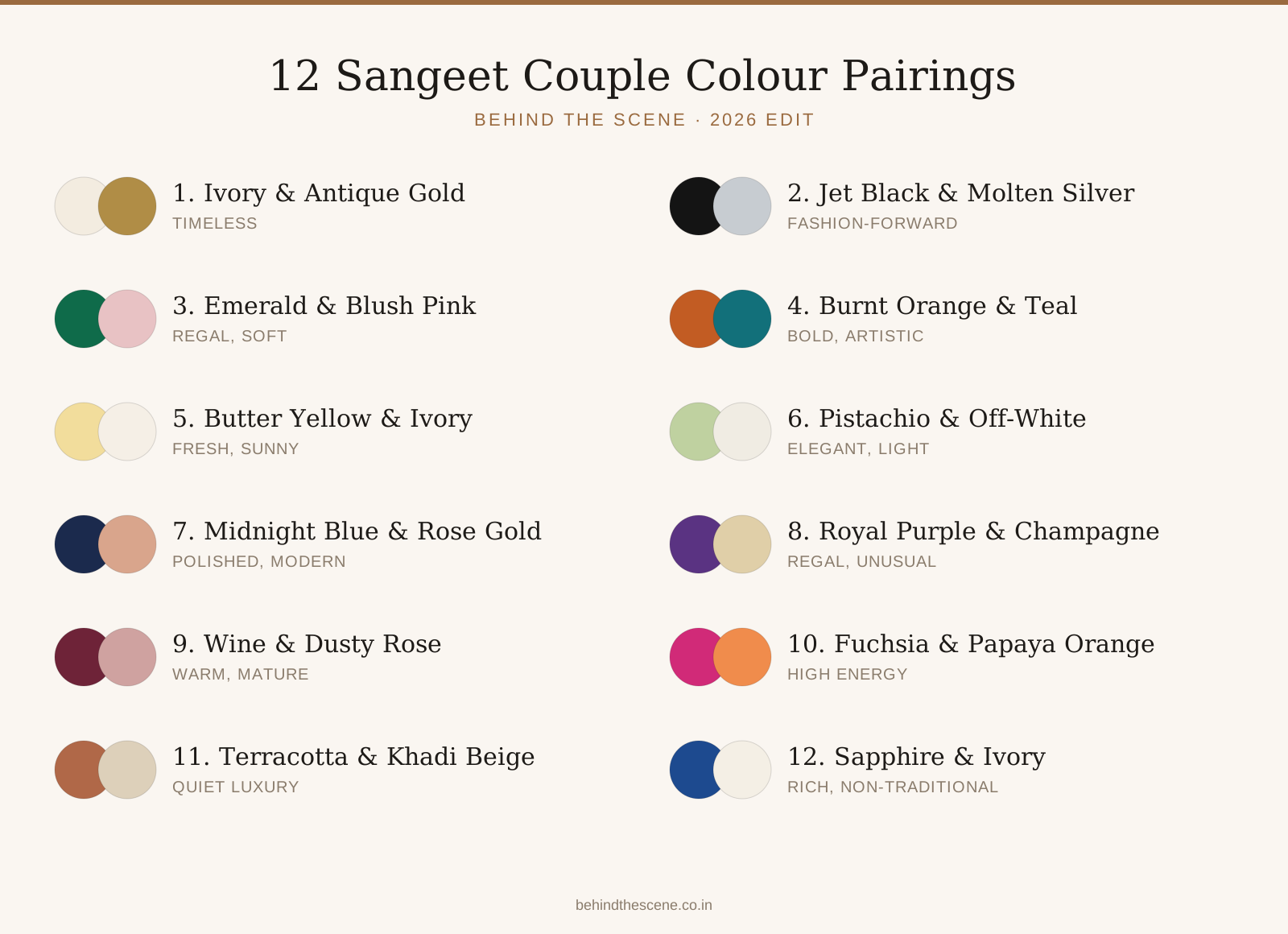
Save this for your outfit shortlist.
Quick comparison: which colour pair is right for you?
A fast way to shortlist — matched to the time of day, the kind of venue, and the mood each pairing gives off.
Ivory & antique gold — Evening · palace, haveli, ballroom · timeless.
Jet black & molten silver — Night · hotel, urban rooftop · fashion-forward.
Emerald & blush pink — Any time · any venue · regal, soft.
Burnt orange & teal — Evening · desert palace, courtyard · bold, artistic.
Butter yellow & ivory — Day or sunset · poolside, garden · fresh, sunny.
Pistachio & off-white — Day or early evening · garden, lawn · elegant, light.
Midnight blue & rose gold — Evening · ballroom, banquet · polished, modern.
Royal purple & champagne — Evening · grand indoor · regal, unusual.
Wine & dusty rose — Evening · candlelit, intimate · warm, mature.
Fuchsia & papaya orange — Day or early evening · open-air, marquee · high energy.
Terracotta & khadi beige — Day · farm, heritage, forest · quiet luxury.
Sapphire & ivory — Any time · any venue · rich, non-traditional.
Dance-proofing your sangeet outfit
The most beautiful outfit in the room is worthless if you spend the night holding it up. A few things worth insisting on when you order:
For her
Choose flare over weight. An anarkali or sharara gives you movement with far less kilo-count than a fully worked lehenga. If you want a lehenga, ask for the embroidery to be concentrated on the border rather than all-over.
Pin the dupatta, or skip it. A dupatta that needs one hand is a dupatta you will remove by song three. Pre-pleated, pinned at the shoulder, or a cape instead.
Check the armhole. Raise both arms fully in the trial. If the blouse rides up, it will ride up on the dance floor.
Fabric matters. Chanderi, organza, georgette and lightweight tissue breathe and move. Heavy velvet and thick raw silk do not.
Block heels or wedges — not stilettos. You have three hours of dancing ahead.
For him
Ask for a stretch or gusseted lining in the sherwani — most premium tailors will do it if you ask at fitting.
Consider a jacket you can remove. A kurta-and-jacket set means you can drop a layer when the bhangra starts and still look put together.
Skip the heavy safa for sangeet. Save it for the baraat.
Break in the mojris — two weeks minimum.
Accessories and jewellery that support the colour
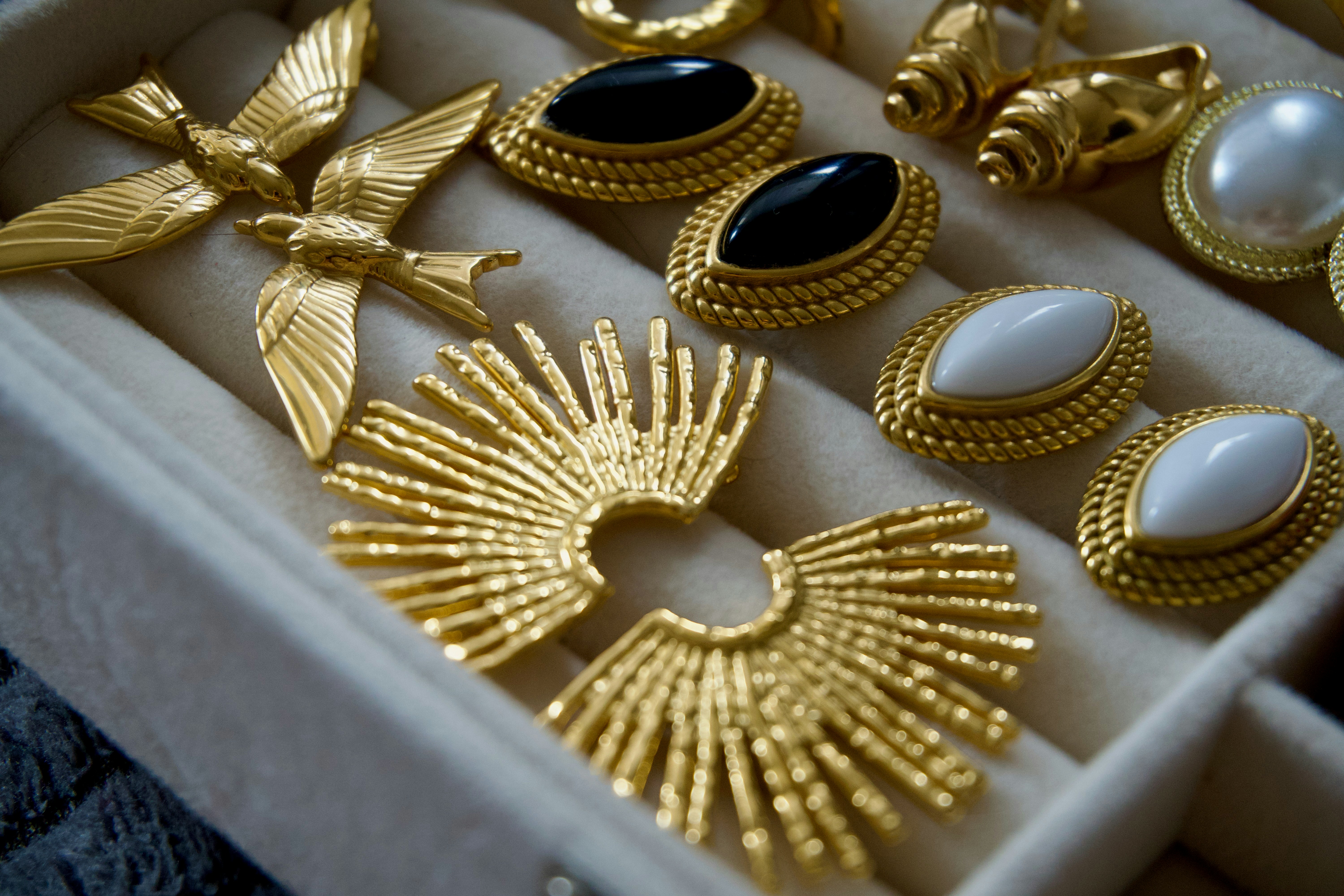
Once the colour is settled, the jewellery decision becomes simple: let the metal follow the undertone.
Warm colours (terracotta, wine, burnt orange, butter yellow, fuchsia) → yellow gold, polki, uncut diamonds, temple jewellery.
Cool colours (sapphire, midnight blue, emerald, purple) → white gold, silver, diamonds, pearls, or contrasting emerald and ruby stones.
Neutrals (ivory, pistachio, off-white, khadi beige) → anything, which is why they are so easy. Antique gold is the most flattering.
For him, keep it to three pieces maximum: a brooch or button set, a stole, and footwear. Every additional element competes with hers in the couple portraits.
One coordination detail worth planning: match your metals to each other, not your colours to each other. If she is in antique gold, his buttons and brooch should be antique gold too. Mixed metals in a two-person photograph is the small thing that quietly makes a look feel unplanned. Our design and styling team usually locks the metal before the fabric for exactly this reason.
5 mistakes couples make with sangeet colours
Matching exactly. Covered above, but it is the most common one. You want to look like a pair, not a uniform.
Picking the colour before seeing the venue lighting. Visit at the same time of day your sangeet will run, and photograph a fabric swatch there on your phone. What you see is what your photographer will get.
Ignoring what the décor is doing. If your stage is deep red and pink florals, a fuchsia lehenga will vanish into it. Ask your planner for the décor palette before you finalise the outfit — not after.
Forgetting the family. Send your two colours to immediate family so nobody arrives in the identical shade. You do not need a family dress code, just a heads-up.
Choosing weight over movement. The heaviest outfit is rarely the best sangeet outfit. Save the weight for the wedding day.
Not sure which of these is right for your venue?
Our team styles couples for sangeets across Udaipur, Jaipur, Goa and beyond — matching outfit palettes to your décor, your lighting and your photographer's plan before a single order is placed.
Book a consultation and we'll build your colour plan with you.
Frequently asked questions
Should the bride and groom match outfits for sangeet?
No — they should coordinate, not match. Wearing the identical shade head to toe makes a couple read as one block of colour in photographs. The better approach is to share one anchor colour that appears as the main colour in one outfit and as a detail or accent in the other.
What colour should you avoid wearing to a sangeet?
Avoid pure white and stark black without texture, since both can read as sombre in Indian wedding photographs. Guests should avoid the bridal red and any colour the couple has announced. For the couple themselves, be cautious with very pale pastels at a night sangeet — warm venue lighting flattens them.
What are the best sangeet outfit colours for 2026?
The strongest 2026 directions are jet black with metallic silver, butter yellow, pistachio green, and bold colour-blocking such as fuchsia with papaya orange. Jewel tones — emerald, sapphire, royal purple — remain the most reliable for evening functions because they deepen under warm light.
Which designers are best for a sangeet outfit?
For brides, Sabyasachi and Abu Jani Sandeep Khosla for heirloom-weight embroidery, Manish Malhotra and Falguni Shane Peacock for shimmer and drama, Tarun Tahiliani and Anamika Khanna for lightweight draping, and Anita Dongre or Abhinav Mishra for softer, dance-friendly pieces. For grooms, Raghavendra Rathore and Shantnu & Nikhil for bandhgalas, Kunal Rawal for modern layered sets, and House of Rohit Bal for classic ivory-and-gold sherwanis.
How much does a designer sangeet outfit cost?
Designer sherwanis from premium Indian labels typically start around ₹50,000 and rise into several lakhs depending on the house and the embroidery. Couture bridal lehengas from top-tier designers generally begin in the low lakhs. Diffusion and prêt lines from the same designers, and rental through authorised partners, are meaningfully more affordable routes to the same aesthetic.
Can the bride wear a gown instead of a lehenga for sangeet?
Yes. Sangeet is the least ritually bound function of an Indian wedding, which makes it the natural place for a draped gown, a sculpted silhouette, a cape set or an Indo-Western ensemble. Designers like Gaurav Gupta and Falguni Shane Peacock build specifically for this slot.
How far in advance should we order sangeet outfits?
Allow four to six months for couture pieces from major design houses, since custom embroidery and fittings take time. Prêt and diffusion lines need roughly four to eight weeks. Book earlier if your wedding falls in peak season, between October and February.
The takeaway
Pick a pairing that suits your venue's light, coordinate rather than match, and choose the version you can dance in for four hours. Everything else — the embroidery, the designer, the jewellery — follows from those three decisions.
If you would like help putting the whole picture together, see how we approach outfit and décor palettes in our real weddings, or browse the rest of our wedding style journal.